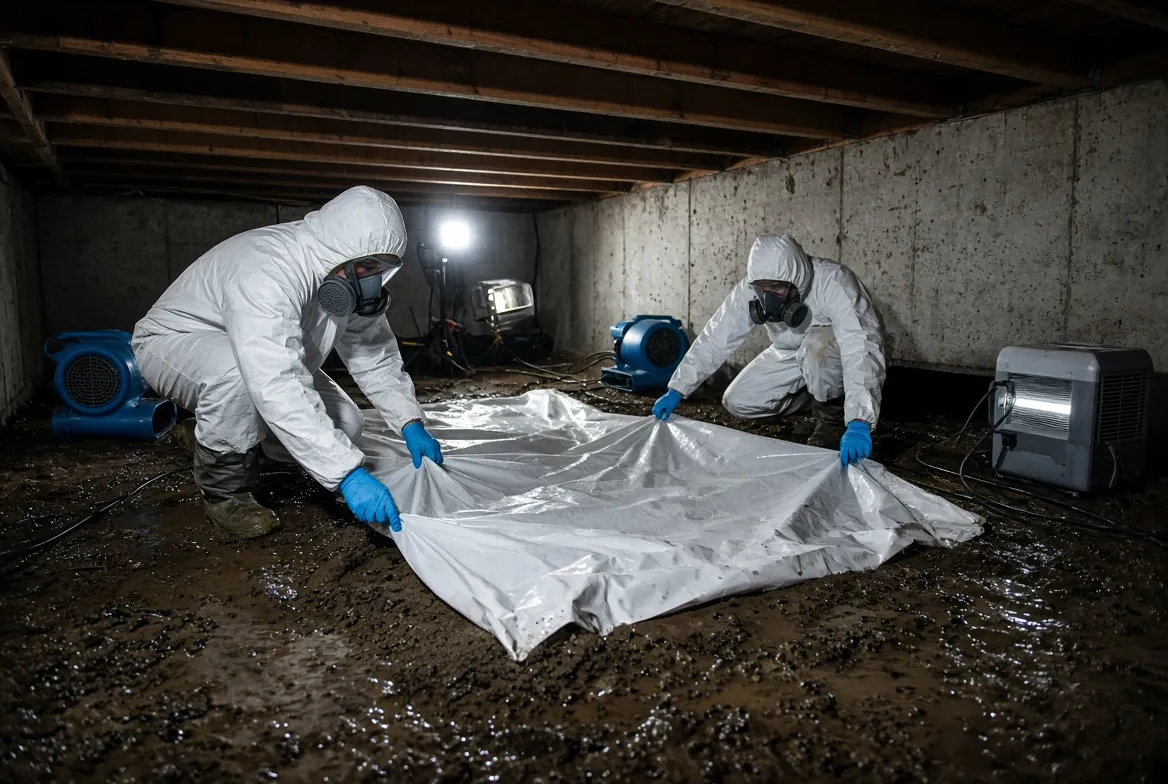
A crawl space is the wettest part of most houses
It is enclosed, it is shaded, it usually sits on bare soil, and it is cooler than the air above it. Every one of those makes it a place where moisture collects and stays.
That matters because your floor is built in it. The joists, girders and subfloor that carry the rooms above are the first things to absorb water, and they lose strength long before the damage is obvious from inside the house. By the time a homeowner notices a soft patch or a musty smell, the moisture has usually been there for months.
Our work is to take the water out, dry the structure back to a measured target, deal with whatever has grown while it was wet, repair what has lost strength, and then close off the way the water got in. Skipping that last part is why so many crawl spaces are dried twice.
What we do
Six services that cover a crawl space water problem from the first inspection through to the repair that follows.
Crawl Space Water Removal
Standing water pumped and extracted from under the house, then the saturated material taken out.
Crawl Space Structural Drying
Joists, girders and subfloor dried back to a measured target with air movers and dehumidification.
Crawl Space Mold Remediation
Contained removal of mold-affected material, HEPA cleaning, and the moisture source shut off.
Crawl Space Vapor Barrier Installation
Sealed polyethylene over the soil and up the piers, so ground moisture stops entering the space.
Crawl Space Drainage and Sump Pump Installation
Interior drainage to collect water, a sump and pump to lift it, and a discharge that takes it away.
Crawl Space Wood and Subfloor Repair
Rotted joists, girders, rim joists and subfloor sections repaired or replaced once the space is dry.
How a crawl space job runs
The order is what makes the difference. Each stage depends on the one before it.
Inspect and find the source
We go into the space, establish whether the water is supply, drain, groundwater or surface runoff, and take moisture readings so there is a baseline to work against.
Remove the water and wet material
Standing water is pumped and extracted, and saturated insulation, barrier and debris come out, because they hold water against the floor framing.
Dry to a target
Air movers and dehumidification bring the joists and subfloor back to a stated moisture content, re-reading marked points until the readings hold.
Remediate what grew
Mold-affected material is removed under containment, surfaces are HEPA cleaned and treated, and floor penetrations are sealed while the work is done.
Repair the structure
Once the space is dry, weakened joists, rim joist and subfloor sections are sistered or replaced and pier support is corrected.
Close off the cause
Vapor barrier, drainage, sump and exterior grading, so the space does not go back to being wet after we leave.
Signs worth acting on
Any one of these is enough reason to have the space looked at.
- A musty or earthy smell indoors, stronger when the HVAC runs
- Floors that feel soft, bouncy, cool or damp underfoot
- Hardwood that has cupped, crowned or opened at the seams
- Insulation hanging down or lying on the crawl space floor
- Standing water, mud or a waterline mark on the piers
- Condensation on ducts and pipes under the floor
- Doors and windows that have started to stick
Why crawl spaces take water
Almost every case comes down to one of these, and the fix is different for each.
- Groundwater rising through the soil as the water table comes up
- Surface runoff entering through foundation vents during heavy rain
- Plumbing failures: supply lines, drains, water heaters
- Soil evaporation from an uncovered or unsealed crawl space floor
- Humid outside air condensing on cool surfaces under the floor
- Downspouts and grading directing water at the foundation
- A failed, undersized or badly discharged sump pump
Where we work
We serve homeowners nationwide. Coverage is being built out state by state, with every city and town in a state listed before the next one is added.
South Carolina
407 cities and towns across all 46 counties.
Common questions
What should I do first if I find water in my crawl space?
Stop the water if you can find a valve, keep people and pets out of the space, and do not run fans into the house before the source is known. Then get the space inspected, because what happens in the first day or two decides whether this is a water removal job or a framing repair job.
How soon does crawl space water become a mold problem?
Mold can establish on damp organic material within roughly 24 to 48 hours at normal indoor temperatures, and a timber floor structure is organic material. That window is the reason crawl space water is treated as urgent even when the volume looks small.
Do you fix the cause or just remove the water?
Both, and in that order. Removing water from a crawl space that will take water again is a recurring cost, so every job starts by establishing whether the water is plumbing, groundwater or surface runoff, and the repair plan follows from that.
Does a crawl space problem affect the air inside the house?
It can. Air moves upward through a house and draws crawl space air into the rooms above through gaps around pipes, ducts and floor penetrations, which is why a damp crawl space is often first noticed as a musty smell in a hallway rather than below.
Which areas do you cover?
We work nationwide. South Carolina is live now with 407 cities and towns covered, and further states are being added.
Tell us what you are seeing under the house
A description of the smell, the sound of the floor and where the water sits is usually enough for us to say what the space needs.
Tell us what you are seeing under the house and we will tell you what it needs.