The floor feels soft, bouncy or sloped, because the structure under it has been wet too long.
Sustained moisture does not just make a crawl space unpleasant, it takes strength out of the floor. Decay fungi break down the timber, and affected joists, girders and subfloor lose load capacity well before the damage looks dramatic from below. What the homeowner notices upstairs is a soft or bouncy spot, a slope, a squeak that was not there before, or a door that has stopped closing cleanly.
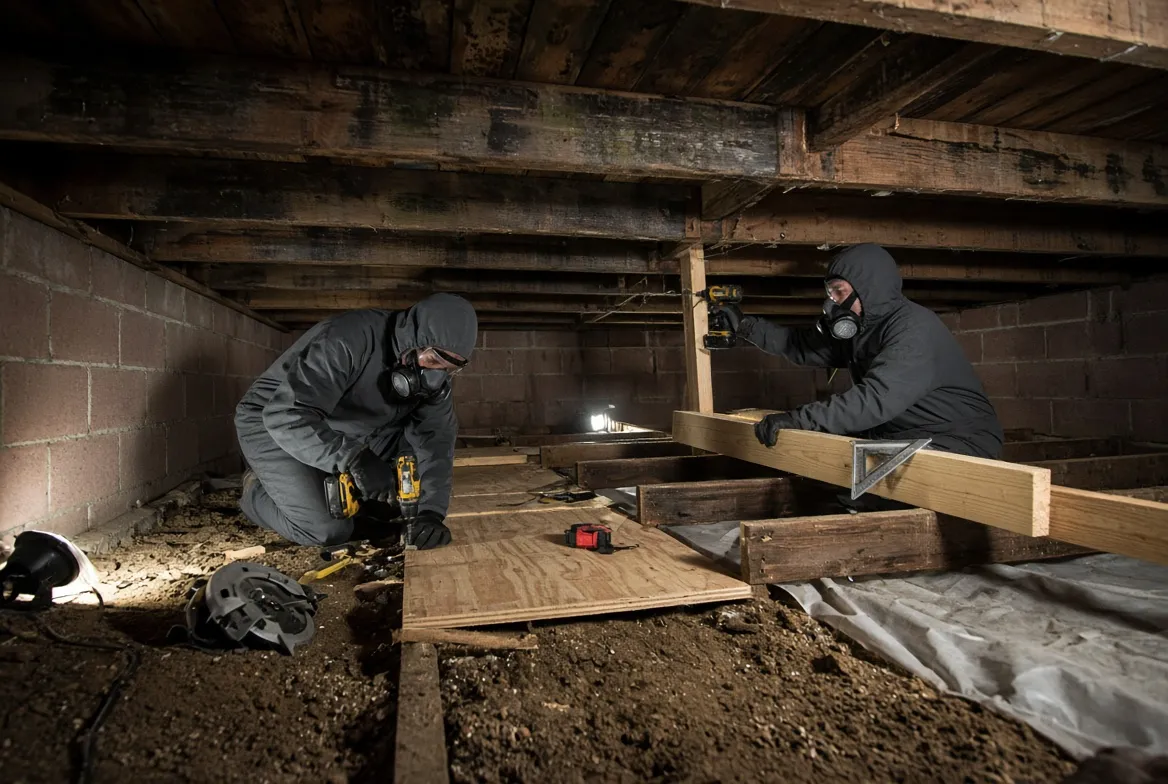
Repair means dealing with the members that have actually lost capacity. Depending on what the inspection finds, that can be sistering new material alongside a weakened joist, cutting out and replacing a rotted joist end where it bears, replacing rim and band joist — which rots early because it sits at the top of the foundation where moisture collects — replacing subfloor sections, or correcting pier and girder support where settlement has left the floor unsupported.
The order is not negotiable. The space has to be dry, and the water source corrected, before new timber goes in. New material installed into a wet crawl space starts absorbing moisture the day it is fitted, and the repair becomes a repeat visit rather than a fix.
You need this if
- Soft, spongy or bouncy areas in the floor above
- Sloping floors, or new gaps at baseboards and door frames
- Doors and windows that have started to stick or not latch
- Squeaks and movement that have appeared or got worse
- Visible decay, crumbling or insect damage on joists or girders
- Piers that have settled, cracked, or lost contact with the girder
What the work includes
- Floor structure inspection with moisture readings recorded
- Temporary support while members are repaired
- Sistering, splicing or replacement of affected joists and girders
- Rim and band joist replacement where decayed
- Subfloor section replacement
- Pier and girder support correction where needed
- Reinstatement of vapor barrier and insulation
How we do it
Inspect and measure
Survey the floor structure, probe suspect members, and record moisture content so repairs are not built into wet timber.
Confirm the space is dry
Check that the water source has been corrected and the framing has reached target moisture before any new material is fitted.
Support and relieve load
Temporarily support the floor so damaged members can be worked on safely without loading the repair.
Repair or replace members
Sister, splice or replace affected joists, girders, rim joist and subfloor sections, restoring proper bearing at each end.
Correct support and finish
Address pier and girder support where settlement has left the floor unsupported, then reinstate barrier and insulation.
Common questions
Can a rotted joist be repaired, or does it need replacing?
Both are used. Where a member has lost some capacity but is sound at its bearings, sistering new timber alongside it is often appropriate. Where the end has decayed where it bears, or the loss is extensive, that section needs replacing. The inspection decides, not a preference.
Why does the rim joist rot before anything else?
Because of where it sits. The rim or band joist runs around the top of the foundation, where moisture from the wall, the sill and poor exterior drainage all concentrate, and it is frequently covered by insulation that holds that moisture against it.
Should repairs happen before or after drying?
After. New material fitted into a crawl space that is still wet, or whose water source has not been corrected, begins taking on moisture immediately. Drying and source correction first is what makes the repair last.
Is bouncy flooring always a crawl space problem?
Not always — it can be span, joist spacing or subfloor thickness from the original construction. But where it is new, localized, or paired with a musty smell or a damp space below, the cause is usually moisture damage to the structure underneath.
The rest of the sequence
Wood and subfloor repair is usually one stage of a larger job. These are the others.
Crawl Space Water Removal
Standing water pumped and extracted from under the house, then the saturated material taken out.
Crawl Space Structural Drying
Joists, girders and subfloor dried back to a measured target with air movers and dehumidification.
Crawl Space Mold Remediation
Contained removal of mold-affected material, HEPA cleaning, and the moisture source shut off.
Crawl Space Vapor Barrier Installation
Sealed polyethylene over the soil and up the piers, so ground moisture stops entering the space.
Crawl Space Drainage and Sump Pump Installation
Interior drainage to collect water, a sump and pump to lift it, and a discharge that takes it away.
Need wood and subfloor repair for your crawl space?
Call (888) 724-1354 and describe what you are seeing. We will tell you whether this is the right stage to start at.
Tell us what you are seeing under the house and we will tell you what it needs.