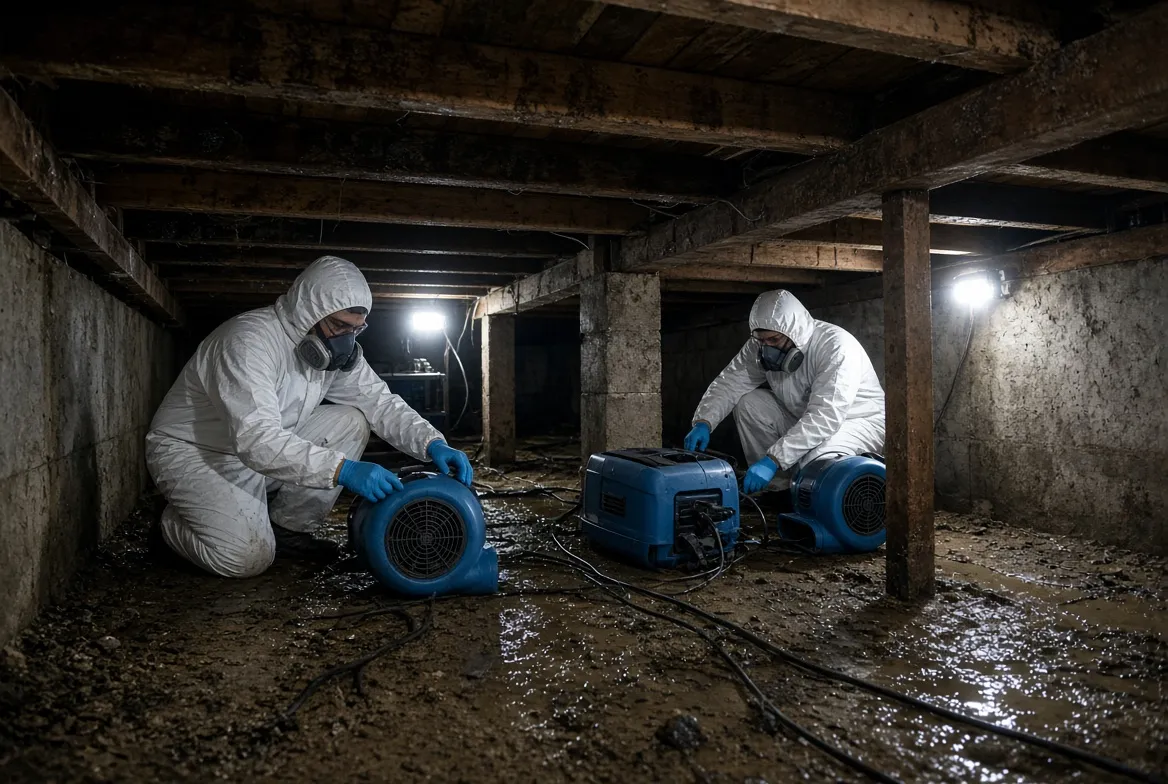
The water is gone but the wood is still wet, and wet wood is what fails.
Taking the water out is not drying. Once standing water is removed, the moisture that matters has already moved into the wood — the joists, the girders, the rim joist and the underside of the subfloor — and into the soil beneath. That moisture comes back out slowly, and only if the air around it is drier than the wood.
Structural drying means putting that process under control instead of hoping for it. Air movers break the saturated boundary layer sitting against the timber so moisture can leave the surface; dehumidifiers take that moisture out of the air and off site, rather than letting it redeposit on the next cool surface. In a crawl space the two have to work together, because moving air around a closed damp space without removing water vapor simply relocates the problem.
The target is a number, not a feeling. Framing lumber is generally considered dry in service somewhere around 12 to 15 percent moisture content, and wood decay fungi need sustained moisture well above that to establish. We take readings at the same marked points through the job so you can see the curve flatten, and we stop when the readings say so.
You need this if
- Water has been removed but the space still smells damp
- Moisture meter readings above roughly 16 percent in joists or subfloor
- Condensation returning on ducts or pipes after the space was cleared
- Dark staining or surface growth on joists and the subfloor underside
- Floors above the space still feel cold or slightly soft
- Relative humidity in the crawl space staying above 60 percent
What the work includes
- Moisture mapping with marked, repeatable reading points
- A drying plan with stated target moisture content
- Air movers and dehumidification sized to the crawl space
- Monitoring through the job with readings recorded
- Temperature and relative humidity logging in the space
- A final reading set confirming the wood reached target
How we do it
Map the moisture
Take readings across joists, girders, rim joist and subfloor, and mark the points so every later reading is comparable.
Set the drying plan
Decide equipment placement and target readings based on how wet the wood is, how large the space is and how it is enclosed.
Install air movement
Position air movers to break the damp layer against the framing and keep air moving through the low and dead-end areas.
Dehumidify
Run dehumidification sized to the space so the moisture leaving the wood is actually removed, not recirculated.
Monitor to target
Re-read the marked points through the job, adjust equipment as the curve flattens, and finish when readings hold at target.
Common questions
How long does drying a crawl space take?
It depends on how wet the wood got, how enclosed the space is and the weather, so a straight answer before anyone has taken a reading is a guess. What matters is that the job is finished against a moisture target rather than a fixed number of days — drying stopped early is the most common reason a crawl space problem comes back.
Can I just put a household dehumidifier down there?
A small domestic unit is usually well short of what an open, soil-floored crawl space needs, and it has nowhere to send the water it collects. It can help hold a space that is already dry, but it rarely pulls saturated framing back to target.
Why does my crawl space smell worse after the water was pumped out?
Because the water left but the moisture did not. Damp wood, damp soil and damp insulation keep feeding microbial growth, and the smell often becomes more noticeable once the space is opened up and air starts moving through it.
What moisture reading should I be looking for?
Framing lumber is generally considered as dry in service in the region of 12 to 15 percent moisture content, with sustained readings above the high teens being the range where decay becomes a real risk. The right target depends on your climate and construction, which is why we set it per job and write it down.
The rest of the sequence
Structural drying is usually one stage of a larger job. These are the others.
Crawl Space Water Removal
Standing water pumped and extracted from under the house, then the saturated material taken out.
Crawl Space Mold Remediation
Contained removal of mold-affected material, HEPA cleaning, and the moisture source shut off.
Crawl Space Vapor Barrier Installation
Sealed polyethylene over the soil and up the piers, so ground moisture stops entering the space.
Crawl Space Drainage and Sump Pump Installation
Interior drainage to collect water, a sump and pump to lift it, and a discharge that takes it away.
Crawl Space Wood and Subfloor Repair
Rotted joists, girders, rim joists and subfloor sections repaired or replaced once the space is dry.
Need structural drying for your crawl space?
Call (888) 724-1354 and describe what you are seeing. We will tell you whether this is the right stage to start at.
Tell us what you are seeing under the house and we will tell you what it needs.