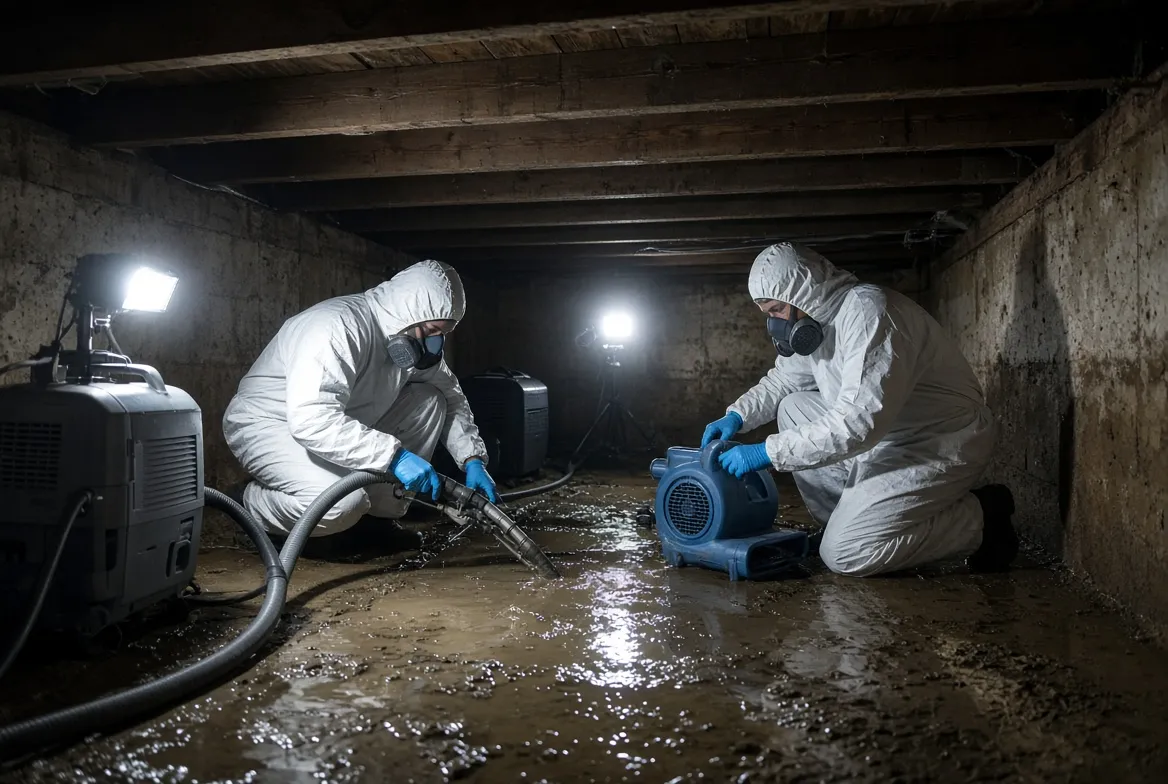
There is water sitting under your floor and it is not draining away on its own.
Standing water in a crawl space does not evaporate out through a vent. The space is shaded, enclosed and cooler than the air above it, so the water sits, wicks into the soil, and raises the humidity under your entire floor until the joists and subfloor start taking it on. Removing the water is the first job, and it has to happen before any drying, barrier or repair work is worth doing.
We pump what can be pumped and extract the rest, then pull out the material that holds water and will not give it back: soaked fiberglass batts, collapsed ductwork insulation, cardboard, stored belongings and any debris sitting in the mud. Wet insulation is the single most common reason a crawl space stays damp for months after the water itself is gone, because it keeps a reservoir pressed against the floor framing.
At the same time we trace where the water came from. A burst supply line, a failed water heater, a leaking drain, groundwater pushing up through the soil and surface water running in from outside all leave different evidence. Water removal that ignores the source just buys a few dry weeks.
You need this if
- Visible standing water, mud or a waterline mark on the piers
- A musty smell that gets stronger when the HVAC runs
- Floors that feel cool, damp or cupped underfoot
- Condensation on ductwork or the underside of the subfloor
- Insulation hanging down or lying on the ground
- A sudden jump in your water bill with no fixture leaking
What the work includes
- Full crawl space inspection with the water source identified
- Pumping and extraction of standing water
- Removal and disposal of saturated insulation, barrier and debris
- Cleaning of soil, piers and footings
- Moisture readings on joists and subfloor, recorded for your file
- A written account of what caused it and what the space needs next
How we do it
Find the source
Inspect the full crawl space, identify whether the water is supply, drain, groundwater or surface runoff, and stop the active intrusion.
Pump and extract
Remove standing water with pumps and extraction units, working to the low points where water collects against footings.
Strip saturated material
Take out wet insulation, vapor barrier, debris and anything porous holding water against the framing.
Clean the substrate
Remove mud and organic deposits from soil, piers and footings so the space can actually dry.
Measure and hand over
Record moisture readings in the joists and subfloor so you have a baseline, and set out what drying or repair the space needs next.
Common questions
How quickly does water under a house need to come out?
Quickly. Wood begins absorbing moisture immediately, and mold can establish on damp organic material within roughly 24 to 48 hours at normal indoor temperatures. The longer water sits, the more of the job shifts from extraction to drying, remediation and framing repair.
Will the crawl space dry out by itself if I open the vents?
Usually not, and in humid weather venting makes it worse. When outside air is warmer and wetter than the crawl space, bringing it in deposits moisture on the cooler surfaces instead of carrying it away. That is why vented crawl spaces in humid climates often read higher humidity in summer than in winter.
Do I need to remove the wet insulation, or will it dry?
Saturated fiberglass batts should come out. Once wet they lose most of their insulating value, they sag away from the subfloor, and they hold water against the floor framing for weeks. Replacing them after the space is dry costs less than the rot they cause.
Is water in a crawl space covered by homeowners insurance?
It depends entirely on the cause. Sudden failures such as a burst pipe are commonly covered; long-term seepage, groundwater and surface flooding usually are not, and flood damage generally needs separate flood coverage. Document everything before work starts and check with your carrier.
The rest of the sequence
Water removal is usually one stage of a larger job. These are the others.
Crawl Space Structural Drying
Joists, girders and subfloor dried back to a measured target with air movers and dehumidification.
Crawl Space Mold Remediation
Contained removal of mold-affected material, HEPA cleaning, and the moisture source shut off.
Crawl Space Vapor Barrier Installation
Sealed polyethylene over the soil and up the piers, so ground moisture stops entering the space.
Crawl Space Drainage and Sump Pump Installation
Interior drainage to collect water, a sump and pump to lift it, and a discharge that takes it away.
Crawl Space Wood and Subfloor Repair
Rotted joists, girders, rim joists and subfloor sections repaired or replaced once the space is dry.
Need water removal for your crawl space?
Call (888) 724-1354 and describe what you are seeing. We will tell you whether this is the right stage to start at.
Tell us what you are seeing under the house and we will tell you what it needs.