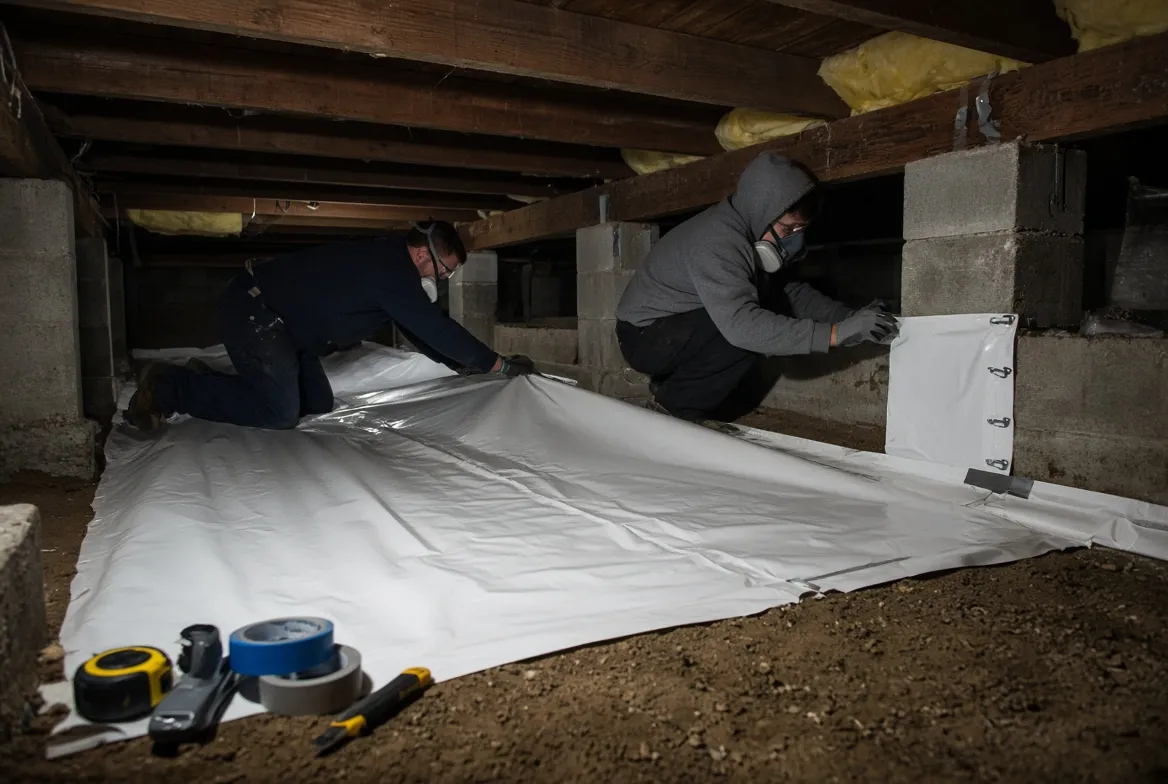
Bare soil under the house is evaporating moisture into the space every day.
An uncovered crawl space floor is a moisture source that never switches off. Soil holds water, and that water evaporates upward into the enclosed space continuously, which is why a crawl space with bare earth can read high humidity even when nothing has leaked and no water is visible. A vapor barrier is the sheet that stops that exchange.
Done properly it is more than plastic laid on dirt. The sheeting is run across the full soil surface, overlapped and sealed at the seams, carried up the foundation walls and around the piers, and sealed at the perimeter so ground moisture cannot track around the edges. Loose, torn or unsealed sheeting — which is what we most often find already in place — behaves much more like bare soil than like a barrier.
There is a choice to make about how far to take it. A vapor barrier covers the ground and controls soil moisture. Full encapsulation seals the ground, walls and vents and brings the space inside the building envelope, usually with a dehumidifier, which controls humidity rather than just soil evaporation. Encapsulation costs more and is the right answer more often in humid climates, but it is a decision that should follow a humidity reading rather than a sales preference.
You need this if
- Bare soil anywhere on the crawl space floor
- Existing sheeting that is torn, bunched or not sealed at seams
- Barrier that stops short of the walls and piers
- Crawl space relative humidity holding above 60 percent
- Condensation on ducts, pipes or the subfloor underside
- Cupping hardwood or a persistent musty smell above
What the work includes
- Clearing and preparation of the crawl space floor
- Reinforced polyethylene barrier across the full soil area
- Overlapped and sealed seams
- Barrier carried up and sealed to walls and piers
- Humidity reading before and after installation
- A recommendation on encapsulation and dehumidification, with reasons
How we do it
Prepare the ground
Clear debris, old torn sheeting and sharp material, and grade the soil so the barrier lies flat and will not be punctured.
Lay and overlap
Run reinforced polyethylene across the whole soil surface with generous overlaps at every seam.
Seal the seams
Tape and seal overlaps so the sheet behaves as one continuous membrane rather than separate panels.
Carry up walls and piers
Take the barrier up the foundation walls and around each pier, then seal it there so moisture cannot track around the edge.
Decide the humidity strategy
Read the humidity with the barrier in place and confirm whether the space also needs vent sealing and dehumidification to hold target.
Common questions
What is the difference between a vapor barrier and encapsulation?
A vapor barrier covers the soil and stops ground moisture evaporating into the space. Encapsulation goes further — ground, walls and usually the vents are sealed and the space is brought inside the building envelope, normally with a dehumidifier to control humidity directly. Encapsulation does more and costs more.
I already have plastic down there. Is that enough?
Often not. Most of the sheeting we find has been laid loose, has torn, has pulled away from the walls or was never sealed at the seams. Unsealed, incomplete sheeting lets ground moisture track around and through it, and performs much closer to bare soil than to a finished barrier.
Should the crawl space vents be closed?
It depends on your climate. In humid regions, open vents often bring in air that is wetter than the crawl space, which deposits moisture on cool surfaces instead of removing it — so sealing vents and controlling humidity mechanically usually performs better. In drier climates venting can work. This should follow readings, not a rule.
Will a barrier fix water that is already coming in?
No. A barrier manages soil moisture and vapor, not liquid water under pressure. If groundwater or surface runoff is entering the space, that needs drainage and a sump before a barrier will do its job.
The rest of the sequence
Vapor barrier is usually one stage of a larger job. These are the others.
Crawl Space Water Removal
Standing water pumped and extracted from under the house, then the saturated material taken out.
Crawl Space Structural Drying
Joists, girders and subfloor dried back to a measured target with air movers and dehumidification.
Crawl Space Mold Remediation
Contained removal of mold-affected material, HEPA cleaning, and the moisture source shut off.
Crawl Space Drainage and Sump Pump Installation
Interior drainage to collect water, a sump and pump to lift it, and a discharge that takes it away.
Crawl Space Wood and Subfloor Repair
Rotted joists, girders, rim joists and subfloor sections repaired or replaced once the space is dry.
Need vapor barrier for your crawl space?
Call (888) 724-1354 and describe what you are seeing. We will tell you whether this is the right stage to start at.
Tell us what you are seeing under the house and we will tell you what it needs.