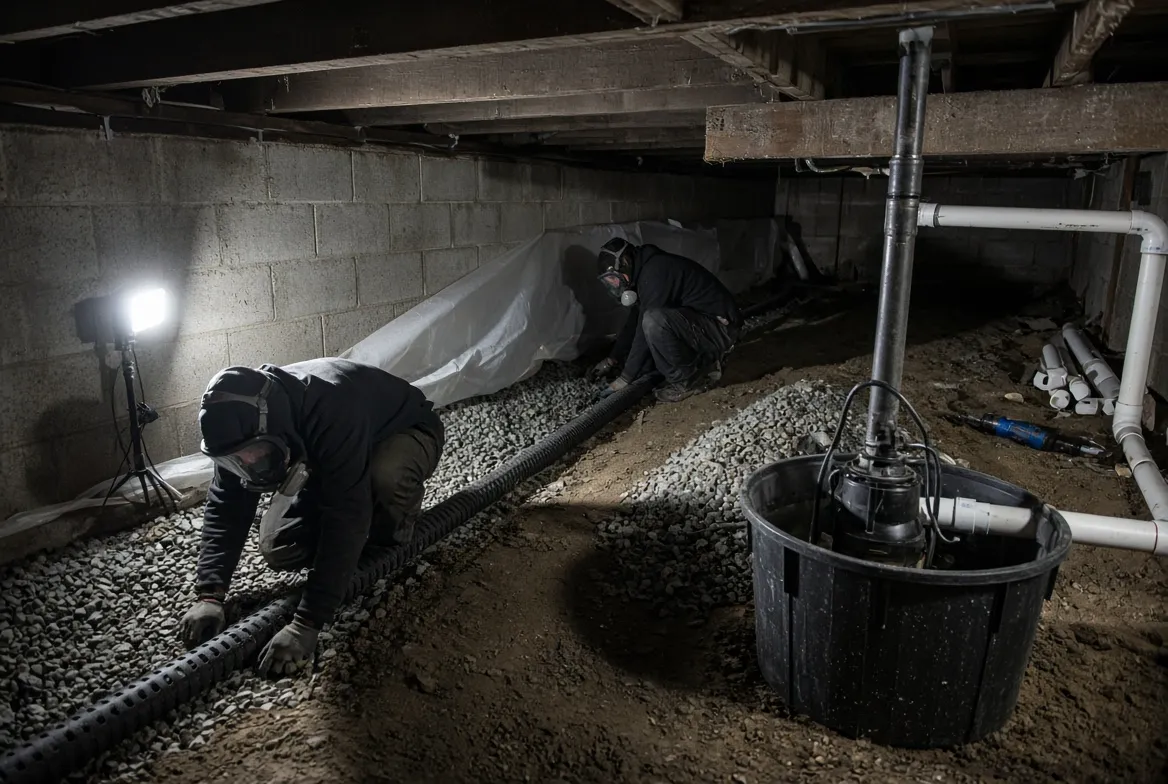
Water keeps coming back, so it needs somewhere to go rather than somewhere to sit.
When a crawl space takes water repeatedly, removing it each time is a subscription rather than a repair. Drainage changes the outcome by giving water a defined path out: a collection system at the low point of the space, a sump basin for it to gather in, a pump to lift it, and a discharge line that puts it far enough from the foundation that it does not come straight back.
The collection side is usually perforated pipe in a gravel bed, set below the level of the crawl space floor along the walls or across the areas where water arrives. It intercepts water moving through the soil before it surfaces. The sump sits at the lowest point, and the pump is sized to the volume the space actually sees, with a check valve so lifted water does not run back down the pipe.
The discharge matters as much as the pump and is where these systems most often fail. A line that empties next to the foundation simply recirculates the same water; one that freezes, crushes or discharges onto a neighboring property creates a different problem. Alongside that, the cheapest water you will ever manage is the water you keep away from the house in the first place, so grading and downspout discharge get looked at as part of the same job.
What is different about this in South Carolina
Drainage design splits along South Carolina's geology. On the coastal plain the water table is shallow, so water rises into the crawl space from below and the system has to be built around a sump that can keep up with a high standing water level — sometimes tidally influenced near the coast.
Through the Piedmont and the Upstate the soil is clay, which sheds water instead of absorbing it. There the water arrives sideways as runoff during heavy rain, and exterior grading, downspout discharge and interception often do more of the work than the pump does.
You need this if
- Water returns in the same place after every heavy rain
- A waterline or silt mark on piers or foundation walls
- Soil that stays soft or muddy long after the weather clears
- An existing pump that runs constantly or has stopped working
- Discharge piping that ends within a few feet of the foundation
- Ground sloping toward the house, or downspouts emptying at the wall
What the work includes
- Assessment of water source, arrival points and low spots
- Perforated collection pipe in a gravel bed
- Sump basin set at the low point
- Sump pump sized to the space, with check valve
- Discharge line routed clear of the foundation
- Review of exterior grading and downspout discharge
- Test of the installed system under load
How we do it
Work out where the water comes from
Establish whether it is groundwater rising, surface runoff entering, or both, and find the arrival points and low spots.
Set the collection line
Install perforated pipe in a gravel bed below floor level along the walls or arrival areas, so water is intercepted before it surfaces.
Fit the sump basin
Place the basin at the true low point, bedded so fines do not migrate in and clog the system.
Install and size the pump
Fit a pump matched to the volume and lift the space needs, with a check valve so lifted water cannot run back.
Run the discharge and fix the outside
Take the discharge well clear of the foundation to a safe, legal discharge point, then correct grading and downspouts so less water arrives at all.
Where we do this in South Carolina
Crawl Space Drainage and Sump Pump Installation is available in all 407 South Carolina cities and towns we cover, across every one of the 46 counties. See the full South Carolina coverage list.
- Columbia
- Greenville
- Charleston
- Myrtle Beach
- Summerville
- Spartanburg
- Rock Hill
- Anderson
- Lexington
- Florence
- Sumter
- Greer
- Simpsonville
- Mount Pleasant
- North Charleston
- Aiken
- Fort Mill
- Conway
- Easley
- Greenwood
- Goose Creek
- West Columbia
- Beaufort
- Orangeburg
- North Augusta
- Lancaster
- Gaffney
- Hilton Head Island
- Taylors
- Bluffton
- Seneca
- Irmo
- Hartsville
- Moncks Corner
- Inman
- Clover
- York
- Georgetown
- Ladson
- Darlington
Common questions
Do I need drainage, or will a vapor barrier be enough?
A barrier handles soil moisture and vapor. If liquid water is entering the space — after rain, or as the water table rises — it needs drainage and a sump as well, because a barrier laid over water simply floats on it.
Where should the sump pump discharge to?
Far enough from the foundation that the water does not track straight back in, to an discharge point that is legal where you live. Discharging next to the wall is the most common fault we find, and it is why some systems run continuously.
Does a sump pump need a backup?
Consider one if the space floods during storms, because storms are when power fails — which is exactly when the pump is needed. A battery backup or a water-powered secondary is worth discussing if your water arrives with the weather.
Can grading and gutters fix it without a sump?
Sometimes, and it is always worth checking first, because exterior water is the cheapest to deal with. Where the problem is surface runoff from a roof or a slope, fixing discharge and grade can be enough. Where the water table itself rises into the space, it cannot.
Other crawl space services in South Carolina
Crawl Space Water Removal in South Carolina
Standing water pumped and extracted from under the house, then the saturated material taken out.
Crawl Space Structural Drying in South Carolina
Joists, girders and subfloor dried back to a measured target with air movers and dehumidification.
Crawl Space Mold Remediation in South Carolina
Contained removal of mold-affected material, HEPA cleaning, and the moisture source shut off.
Crawl Space Vapor Barrier Installation in South Carolina
Sealed polyethylene over the soil and up the piers, so ground moisture stops entering the space.
Crawl Space Wood and Subfloor Repair in South Carolina
Rotted joists, girders, rim joists and subfloor sections repaired or replaced once the space is dry.
Drainage and sump pump anywhere in South Carolina
Call (888) 724-1354 and tell us your town and what the space looks like.
Tell us what you are seeing under the house and we will tell you what it needs.